Tuesday, April 23, 2013

Making Your Baby Registry: items to consider

There are very few items that I believe truly fit into the category of "must-haves" for babies. Most of the items found in the store are really what I would classify as wants, rather than needs. If you are
trying to raise a family on a budget, I believe that it is wise to purchase items that will last a long time. These are a few of my recommendations. Remember, different people use different things for their babies and there is not one "right way" to raise a baby. These are simply my recommendations. Also, if you do your registry on amazon.com, you can add things to your registry from any website, not just amazon. Look up the "amazon add button" and make your registry in one place! We had items on our registry from several different stores! On amazon, there is an area for comments, quantities, and priorities. Also, I have included some cute photos of my daughter, just for fun.

This is a working list, so I plan to update it as I think of things. If you have other suggestions to add to the list, please leave a comment! I tried to include links to specific items.

Things to consider:
  • COLORS- Many of these items will be used by all of your children, not just the first one. If you plan to have more babies later, you might not want to buy the bright pink high chair or the neon purple stroller. That is something to think about. We chose not to find out the gender of our baby, so we ended up with a lot of green and yellow clothes, but for our big baby gear we purposely selected gender-neutral colors. Also, we stayed away from trendy color combinations that could easily go out of style soon and stuck with the classics. Again, that is your choice. For items that would be very visible in our house (like a bouncer, and a high chair), we chose to stick with more neutral colors that would blend into our décor rather than bright "baby colors".
  • RESEARCH- It is worth the time and effort to pick out the baby gear that you actually want, rather than just walking around a store adding things to a registry. I did a ton of research and there are still things I would have done differently. Read the reviews on amazon. Look up the products on their real websites. Find out where things are made and what they are made from and make informed decisions. I would rather have a few items that are really nice and really useful than a house full of gimmicky items that I might use once.
  • STORAGE - Do things fold up for storage? Is it worth getting both a bureau and a changing table or do you only really need the bureau? Think about where you plan to store baby things between use or between babies.
  • PLAN AHEAD - Think about the things your baby will need eventually. Planning for newborn gear is easy, but planning what you will want down the road is harder.
  • PRIORITIZE- It is easy to get carried away with adding toys, clothes and neat gadgets to your registry. However, when you have 300 items on your registry, your friends and family may not know what you really need and you may end up having to purchase all of your important baby gear yourself.

  1. Baby Carrier - Yes, this is the top of the list for me. I actually have three baby carriers, a snugli, Moby wrap, and Boba Carrier. Do you need three? No. I do believe that you need at least one. This is a great article that explains why baby carriers (ones that properly support the baby) are important. I suggest purchasing a carrier that will work for a long time, like the Boba, which can work for infants and toddlers. The newly updated version even works for a newborn! I haven't seen one in person, but I wish I had discovered the Baby K'tan before making my registry because it is so versatile and so easy to use, but it comes in sizes, so it won't necessarily work for everyone in your household.
  2. Car Seat(s) - We have the Chicco Keyfit 30. We also like the Keyfit 30 Magic. There is quite a price range for infant car seats. I hear that what you are really paying for is sturdiness, convenience and comfort. We have to travel long distances to get anywhere, so we opted for a nice car seat. The Keyfit
    30 is the easiest seat to use that I have seen and very supportive and comfy for the baby. The handle is very easy to move (if you are pushing both orange buttons) and the straps are easily loosened and tightened to get baby in and out of the seat with ease. However, the sun shade on it stinks. If you have more than one vehicle that you use regularly, you may want to consider adding an additional car seat base to your registry. Also, I know that some people opt for a convertible seat rather than a true infant seat, but I recommend the carrier type for young babies. In winter, the seat warm in the house, which makes transitions to the car more pleasant. For sleeping infants, bringing the entire seat to and from the car is less likely to wake them than physically moving them to and from the seat in the car. Our infant car seat works for babies up through 30lbs, but that would be ridiculous to carry around. We are going to purchase a convertible car seat for her first birthday which can be used rear-facing and forward-facing. You may want to consider adding the next car seat to your registry too. We are trying to decide between a Recaro Proride or a Britax of some kind. [UPDATE: We chose the Peg Perego convertible seat and love it!]
     
  3. Crib (Cradle, Pack 'n Play, Co-sleeper, Bassinet, or Hammock) - Unless you are planning to always have the baby in your bed, you will need someplace to lay him or her down for the night and naps. We chose a crib that can convert into a toddler bed, day bed, and double bed. We also have a cradle that was my great-great-grandmother's but it only worked until our
    daughter could roll over. A bassinet or hammock only works for a few months as well. I plan to ask for a co-sleeper of some kind when we are expecting our next baby so we can keep the baby close while I heal from childbirth. With a baby bed, you will also need a mattress, cotton fitted sheets (we like the jersey-knit kind that are made from t-shirt material) and 100% cotton blankets. I wouldn't bother registering for blankets unless you are very attached to a certain set, because that is a standard go-to for baby showers and we were blessed to be showered with them. We especially like our quilts and stretchy blankets, since the quilts provide some warm weight, and the stretchy ones are great for swaddling and comfort. We have three fitted sheets for our crib. I think we could have done fine with 2. We have a breathable bumper pad that has come in handy. I also recommend a Serendipity Mattress Cover to eliminate the threat of SIDS (refer to my post about SIDS for more info). We bought a pack 'n play and have only used it a handful of times. We use the pack 'n play as a crib when we travel. It is very heavy and takes up a lot of room in the trunk. We probably should have just picked one up at a yard sale. I am still looking for a better option. Babybjorn makes a lightweight travel crib that is close to what I want, but it costs around $250.
  4. Diaper Bag - We actually opted for a Arcteryx messenger-type bag instead of one that is sold as a diaper bag. My husband picked it out. This was my preference. We use cloth diaper and frequently leave town for the day, so we thought we would need a much larger diaper bag. Now that our baby is almost a year old, I think we could have opted for a smaller bag, like the LL Bean bag, and done just fine. It all depends on how much you want to carry with you and how prepared you want to be. Are you the parent that will bring an extra snowsuit with you, just in case, or are you the parent who would rather just carry a diaper or two and a pack of wipes? I like having some necessities in the car, but not necessarily packing a ton of stuff into a diaper bag that I carry everywhere. Again, think about what YOU want to carry. My husband vetoed most of the diaper bags I picked because they looked like diaper bags...so please consider your spouse's opinion if you want help carrying the diaper bag.
  5. Diapers - We opted for cloth diapers for our baby, which I highly recommend, especially if you are on a budget. If you are new to the cloth diapering world, I highly recommend checking out a blog by the name of "Dirty Diaper Laundry". Kim has a Diaper Finder on her site that is really helpful. She also has video reviews and written reviews. I trust her completely when it comes to diapering. We use mostly GroVia all-in-ones and BumGenius Elementals. I would recommend BumGenius 4.0s if you are totally intimidated by cloth diapers because they fit a
    wide range of babies from about 12 pounds right up through potty training and they are very easy to use. Cloth diapers are a big initial investment but will save you thousands in the long run. With cloth diapers, you will need at least two wet bags for the diaper bag, at least two pail liners for at home, a diaper pail of some kind (we use a cheap trash can), cloth-diaper-safe laundry soap, and cloth-diaper-safe rash cream. We also recommend purchasing a diaper sprayer. If you are not using cloth, you will need TONS of disposables, so you should definitely add them to the registry. Your baby will likely be in size 2 for the longest amount of time. I wouldn't ask for tons of newborn diapers because they most likely won't be used all that long before moving to size one. My baby already wore size one when she was born...at 11-months-old she is still in size 2.
  6. Breast Pump - Even if you are a stay-at-home-mom, I recommend having a breast pump anyway. You never know when you might need one. I had to go on some medication for a while that would have gone into my breast milk, and the pump came in very handy. I use my Medela Harmony daily, and I very highly recommend it. You don't need an expensive double electric pump unless you are working full time, I'd say. Check with your insurance company first and see if they will pay for a pump. Many hospitals give out manual pumps if they know you will be breastfeeding. Milk storage bags and bottles with storage caps also come in handy. We use either honeysuckle bags or Lansinoh. We use the Lansinoh Momma bottle (5 oz) and we have two of them. I am also intrigued by the Joovy Boob, but I haven't used those bottles myself. If you are using bottles, a bottle brush is necessary, and you should change them out periodically like you would a toothbrush. We use only slow-flow nipples, regardless of our daughter's age. We use a mug of hot water to warm the milk and that works fine, so I feel that a bottle-warmer is unnecessary unless you are exclusively bottle-feeding.
  7. Bouncer (Swing/Jumperoo/Johnny Jump Up/Pack 'n Play) - I think it is important to have
    somewhere safe to put the baby while you take a shower, shovel 2 feet of snow off the car, or just need to get away for a minute. I don't use the crib for this purpose because I want my daughter to know that  her bed is for sleep, not for playing. I suppose I could have strapped her into her car seat, but she is in it so much already that I think she needs the variety. We have a Babybjorn Babysitter Balance, which is pretty much the top of the line in terms of bouncy seats. You definitely don't have to get something fancy, but it needs to be safe for the baby and it needs to be used properly. I would non get a Bumbo and expect it to serve this function. The bumbo worked for about a month for us, and only ever with supervision. I also really like the Nuna Leaf, but it is expensive. Maybe I can invest in one for the next few babies. I like the Leaf because it has a weight limit high enough that even I can use it!
  8. High Chair - We don't have the space in our kitchen for a stand-alone high chair, so we use a Chicco 360 hook-on chair instead. There are many options out there. I would look for something that is easy to use, easy to wash (both the tray and the seat), sturdy, easy to remove the tray from, hard for a baby to crawl out of, and easy to store between babies.
  9. Stroller - Before having a baby, I thought I would always use a baby carrier and that I would only use a stroller at the airport or mall. Boy, was I wrong. A baby carrier can make things very hot in the summer. We have an umbrella stroller and a jogging stroller. The umbrella stroller is light and folds up
    small, but it works best indoors because the small wheels don't work well on uneven surfaces.
    It is perfect for keeping in the trunk of the car. Our Joovy Zoom 360 jogging stroller can handle just about anything, but it isn't as small or light as our umbrella stroller, and it would be large for pushing around the mall, for example. I highly recommend our jogging stroller. Our umbrella stroller has a great canopy and a reclining seat, but I step on the wheels constantly, which is annoying, so read reviews and see what people are saying about their strollers before you decide to add one to your registry. You also may want to consider storage space on the stroller, adjustable straps and easy recline of the seat, and sun coverage for your baby. I have written a couple of posts about strollers if you are looking for more ideas.
  10. JJ Cole Bundleme - If you live in an area that gets cold in the winter, I really feel that the Bundleme is a necessity. The Bundleme can be used in a car seat or stroller to keep the baby toasty warm as you travel. The part that lines the seat has slots for straps to come through unhindered and the blanket on top zips on to eliminate drafts. We put our daughter in her seat, zip up the sides and stick a hat on her head. If it is really cold, I tuck a blanket up around her shoulders and neck until we are in the car. It is so much easier than messing with baby coats and snowsuits when we are going in the car! We still use snowsuits for playing outside. The Bundleme comes in several styles and colors and two sizes: infant and toddler. We have the original version. We use the infant size in our car seat and the toddler size in our jogging stroller (because that is what we received) which is big for our daughter at the moment, but we put her in a snowsuit too and it works fine.
  11. Baby Bathtub - Yes, you can bathe your baby in the sink, but if you are a first-time parent, a baby tub is a lot easier! There are many options available. We have the Fisher price Rainforest Bath Center which I reviewed here. We don't have a full-size bathtub, so we wanted something that would work for a long time, and our tub is AWESOME. Our daughter has just started bathing in the sink now instead of her tub, at 11-months. I am very interested in the Puj Flyte which you use in the sink, since it is so small. Looking back, we didn't use the tub all that long and it is quite large to store. Maybe I should have gone the Puj and the Prince Lionheart Foldable bathtub since they would take up less space in our tiny cabin. Baby washcloths and hooded baby towels are thinner and softer than real washcloths and towels and we used them for the first couple of months. You don't need many. Our daughter would be happy playing with a washcloth and a few cups in the tub, but there are lots of cool tub toys available. Our daughter loves her Sprig Toys boat set. Eventually I want to get her a rubber duck and some other things but she doesn't have much now. If you have a real bathtub, you may want to consider a kneeling mat for your knees and a soft cover for the faucet. You will want a place to store your tub toys where the water can drain out well. For soap, we use Dr. Bronner's Pure Casti
    le Soap.
  12. Toys and Books -  This is the fun stuff and everyone will give you a different list of things that their kids love. My husband and I decided not to purchase any toys that required batteries but we have been given a few. Our daughter has many wooden toys, puzzles, plastic toys, and teethers. She has 2 baby dolls with soft bodies. At 11-months old, she is happy as a clam sitting on the kitchen floor with a stock pot, a wooden spoon, and some cheerios. We really like the Lamaze toys since there is a lot to do with one toy, which can keep a baby occupied for quite a while in the car or at church. She like to play ball, so I recommend
    having at least one soft ball. When she can't find her ball, she will throw other toys while saying "Ball?" We like our wooden stacking toy and stacking cups.  Silicone teethers since they are safe and soft and the teethers that can go in the fridge and freezer. Our daughter happens to prefer a snowflake silicone cupcake pan to her real teethers, so feel free to think outside the box. In terms of books, we have board books, Indestructibles and regular picture books for our daughter. The board books are sturdy, but it is hard for her to turn the pages well. Also, she discovered recently that if she sucks on them long enough, she can bite off chunks of cardboard. Indestructibles are awesome because they feel more like real books but they can't be torn or wrecked and are machine-washable. They do bend and look used immediately, but it is no big deal. They have no words, and are designed to make you interact with your child about the book illustrations. There are suggestions on the back. We love ours. We also read real picture books, but she isn't allowed to play with them on her own because I want to teach her to take good care of books. I allow her to help me turn the pages, but she is always supervised. She makes short work of magazine she finds, so I know the books wouldn't last long with her toys.
  13. Burp Cloths- We use mostly prefolds or flat diapers, but there are many options available. Make sure that you pack some burp cloths in your hospital bag, since they didn't have anything of the sort there. If your baby spits up a lot, like mine did, you may be going through 10 or 15 cloths each day.
  14. Mirror for rear-facing car seat in car - This is a very important item, and I LOVE mine. We have the Brica Baby In-Sight mirror.
  15. Safety equipment - We chose not to "baby-proof" our entire house. We would rather train our child to follow directions and respect belongings and boundaries, but we still need a safe environment for her. We have a gate for the stairs, because she can climb up but not down. She is so fast and so tempted that a gate was just necessary. We put the gate on the second stair, so she can still practice a little, but won't fall too far. We also have two cupboards that we "child-proofed" because they hold things like bleach and laundry soap. We do have to watch her constantly, but our house is small. We have a pellet stove right in the living room without a fence around it, and we have trained her to stay away from it, telling her that it is "hot". I can explain how we did this in more detail later, if you are interested. We don't do the toilet locks or anything of that sort, but that is up to you.
  16. Health equipment - When our daughter was a baby, I found that biting her nails was easier than trying to trim them because I could feel exactly how far to trim them. Now that she is bigger, I use my own adult nail clippers to trim her nails too. I wouldn't bother buying a bulb syringe unless you are having a home birth, because the ones the hospital gives out are the BEST! When we have our next baby (Lord willing) I also want to purchase a Nose Frida because I have heard such rave reviews and I think that it would have been helpful.  We also found that a baby toothbrush is a great investment and a wonderful teether. We like the Baby Buddy. If you don't already have a thermometer, I recommend purchasing one. We have a

    cheap flexible-tip thermometer for now and it does the trick. I also purchased some liquid infant acetaminophen (dye-free) at the store and I have used it when our daughter's temp has been high enough to affect her sleep. There are different schools of thought on using fever-reducers, so we have only used it at night when the temp was high enough to keep us all up (it was 102.9).
  17. Feeding equipment - There are lots of options out there. I am rather fond of the OXO Tot products, especially the fork and spoon sets but there are cheaper options out there. We have 2
    sets of eating utensils. Eventually I would like to purchase the Oneida progress flatware set eventually. You might want a few bowls, plates, and cups. If you are concerned about using plastic, there are wooden dishes available online or squishy covers that can protect the breakable dishes you already have. Spuds makes safe plastic dishes from potatoes.  I am not a big fan of sippy cups in general, but I really like this cup when we are home. I don't put anything in it that might stain. If you are going to make and freeze your own baby food, I suggest purchasing these Tovolo perfect cube trays. I use my pop maker all the time. Right now I just make breast milk
    pops, but later I intend to make puree pops, or applesauce pops. You may also want to register for some bibs too. I prefer snaps to Velcro in terms of closure on bibs because snaps can't snag hair or sweaters. These have nice wide shoulders and a pocket on the bottom to catch spills and crumbs but I haven't used them personally. I think I would like these Tommee Tippee Explora bibs too. Of the bibs we own, we have had the best luck with the bibs I have knit in garter stitch with cotton worsted yarn.
  18. Nursing Pillow - I chose not to purchase a Boppy pillow after exploring this site but my Brest Friend wasn't quite what I was looking for either.  I wanted this organic buckwheat hull pillow, but when no one bought it for me, I couldn't afford it, so I made my own with buckwheat hulls that I ordered through the health food store. The one I made was awesome, but heavy. I think I'll make a smaller one to use with my next baby. I only used a nursing pillow for the first few months, but it really helped me because my back couldn't take the strain of holding the baby up to nurse or leaning to the side for long periods of time, especially because I had a C-section.
  19. Night light- When my daughter wakes up in the night for a feeding, I try to keep it as dark as possible to keep her from waking up completely. I nurse her in the rocking chair in the living room, and the fire in our pellet stove is enough for me to see where I am going. When we aren't using the stove, I leave the small light over the stove on. Her bedroom is close enough to the kitchen that I can see to navigate her room and tuck her in. I don't change her in the night anymore because she only pees and her diaper can handle it. When she was little, I had to change her because she was often messy in the night, and to keep from waking her up too much, I used a very dim light instead of the overhead light.
  20. Changing Station - We use the top of our daughter's bureau as a changing table. I purchased a changing pad and made 2 covers for it. I use baskets for organization and my husband built some shelves for cloth diaper storage that are within arm's reach. I considered purchasing an
    organic cotton changing pad that didn't have a waterproof cover, just to cut down on the PVC in our home, but I couldn't justify the price. I decided that since she wasn't sleeping on it and it was away from her crib, I wasn't going to worry about it. One of my dear friends doesn't use a changing table for her children at all. She has a changing basket downstairs and a changing basket upstairs, which she can grab and take anywhere, usually on the floor. She keeps her basket stocked with diapers, wipes and rash cream. I prefer taking my daughter to the changing table instead, but it is something to consider. Maybe a basket would work for you.
  21. Pacifiers- If you choose to use pacifiers, you might want to add some to your registry. We like the NUK orthostar silicone pacifiers.
  22. Swim diaper and life jacket - Instead of purchasing disposable swim diapers, I recommend purchasing a reusable swim diaper. Swim diapers are designed to keep poop out of the pool but let pee and water pass right through. I also appreciate having a life jacket that keeps the baby's face out of the water so we can go in boats as a family. Remember that having flotation foam in a bathing suit is not the same as a PFD and may not keep a baby afloat in an emergency.
  23. Clothing - Baby clothing is very expensive, especially when you consider how quickly babies grow into the next size. If you can get clothing second-hand, I recommend it. How much clothing you "need" is based on a number of things: how often your baby spits-up, how often you wash laundry, and how many diaper leaks you are dealing with. We didn't ask for much clothing on our registry, because we were given many hand-me-downs.
    • Onesies are an extra layer that keeps your baby warm. They pop over the head and snap under the crotch. We like Carters brand or Just One You, since they are softer than the Gerber ones.
    • The sleeper or the "sleep and play" is a one-piece garment. It may have snaps or a zipper. I prefer snaps because I can change the baby's diaper without making his or her chest cold and because zippers sometimes rub under the baby's chin and bulge out in ripples. A dear friend of mine prefers zippers because they are so fast and easy and she hates trying to figure out snaps in the night when the baby is crying. If you are not sure what you prefer, get some of each. For the first few months, our daughter wore these day and night. Now she just wears them at night and wears "real clothes" during the day.
    • Nightgowns are easy to use because the bottom is open for quick changes, but they can creep up into the armpits when babies are being held (especially by the inexperienced) so we used them only at night.
    • Tops and bottoms are cute, but can be a pain to use. Our daughter's head didn't fit through many shirts, so the ones that had snaps or button-closures worked the best for us. Onesie tops are an easy solution to the gap that often occurs between the shirt and the pants. We liked elastic-waist pants or pants that had crotch snaps. We would remove jeans and overalls for naps for the comfort factor.
    • Socks and booties are hit-or-miss. We found that the Faded Glory brand of socks stayed on the best. I made some booties that worked well, but the store-bought ones fell right off. For a newborn, shoes are unnecessary. We had some dressy shoes for her dedication, but other than that she didn't use shoes until she started pulling herself up, and even now she prefers soft-soled leather shoes like Robeez (which also stay on very well).
    • Outer layers could include buntings, fleece jackets, sweaters, snowsuits, winter coats etc. If you live in a cold region, make sure that you dress your baby in layers so you can control how warm or cold the baby is. Baby boots are hard to come by and hard to keep on a baby's feet, so I recommend a snowsuit that has attached booties. I have found that most winter gear for babies lacks sufficient insulation, so we can't stay out long. LL Bean does fairly well in this department, but you pay for it monetarily.
    • Hats are good to have. For winter, you will want at least one hat that covers the baby' ears. If your baby hates hats as much as mine does, you may need ties to keep it on. For summer, we have a sun hat with ties under the chin that works well. I think ours is from Target.
    • Dresses and rompers are super-cute and a good solution for summer babies when the heat is unbearable.
Again, this is a working list, but at least it might be a starting point to get you thinking. Remember that different parents and caregivers swear by different products, so ask around and see what works best for your friends and family! Please leave me a comment if there is something you feel I ought to add to this list!

Friday, April 12, 2013

Why a diaper sprayer is an amazing thing: a review of the BumGenius Diaper Sprayer

I don't think that anyone wants to touch toilet water on purpose, but when babies start eating solid foods and their poop changes consistency, you really don't want that in your washing machine, and it won't always be solid enough to just dump into the toilet. I believe that this is the origin of the "dunk and swish" (in the toilet) routine. I watched my mother do the "dunk and swish" when I was a child while silently thinking to myself that I never would. I think that most people who object to cloth diapers just don't want to touch poop, but don't realize that there are alternatives!

From my research, I found that there are two major alternatives to the "dunk and swish" routine. The first alternative is to use flushable liners. These look similar to dryer sheets, but come in rolls. I have seen them made from many different materials. You simply lay the liner in the baby's diaper and hope that the poop is mostly on the liner so you can neatly transfer all of it to the toilet and flush the liner and poop. This works for many people, and honestly, I am considering these for when we are away from home. The downside is that you have to pay for them, so it is a constant expense, and some septic systems can't handle them. In fact, many online reviews state that the liners caused pipes to clog. Our leach field can't handle anything of the sort, so it isn't an option for us when we are home. I do have fleece liners that are re-usable that I use when our daughter has a diaper rash, but these don't really help with the poop situation, since I would then need to get it off the liner.


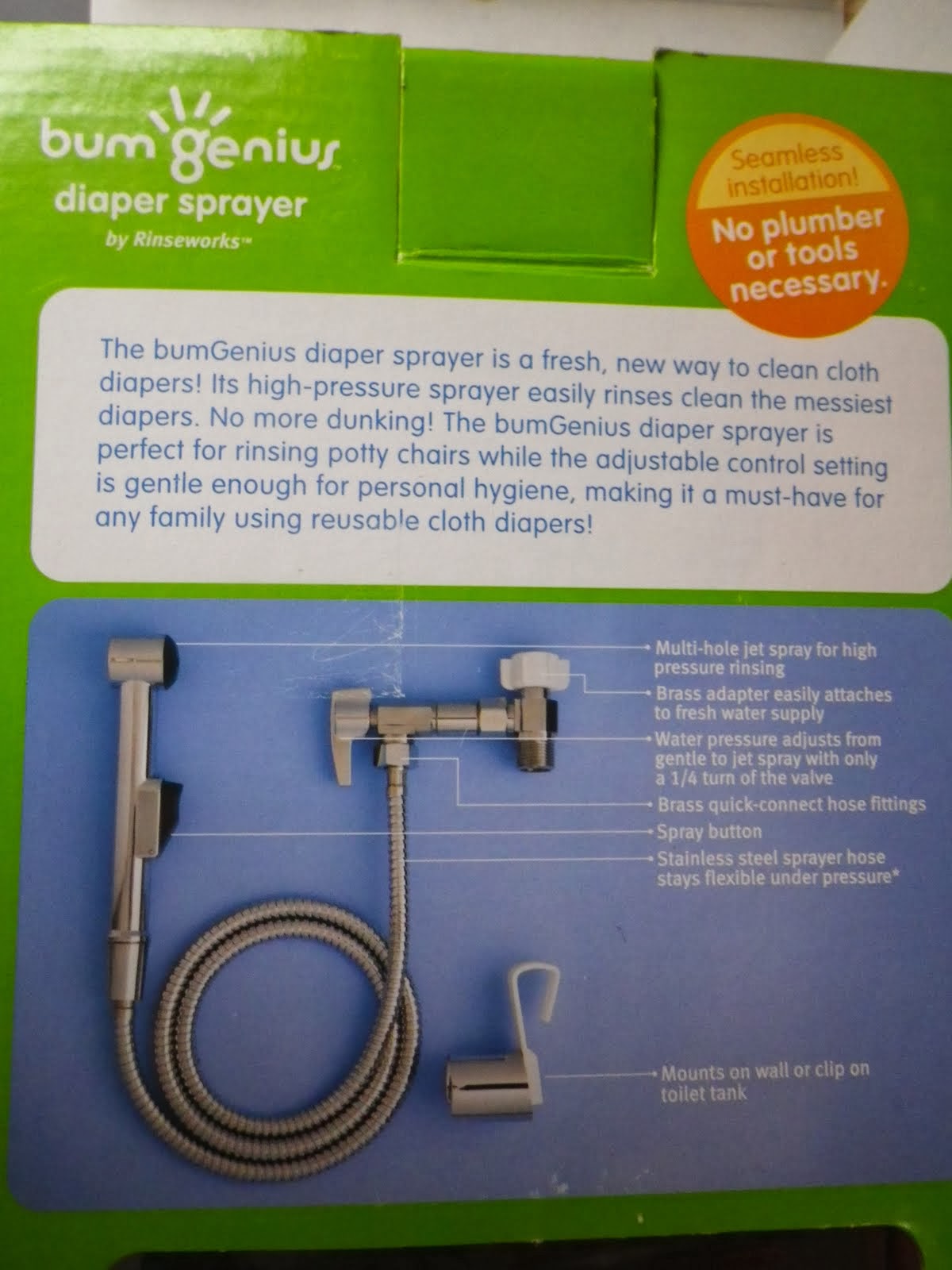
The second alternative is the diaper sprayer. This is an upgraded-version of the sprayer you may have at your kitchen sink. Basically, it hooks up to the pipes that go to your toilet and you can use the water pressure to spray off the diapers and not touch anything gross. After the initial investment, which varies from website to website (we paid nearly $60), the installation and use is pretty easy. There are many brands of diaper sprayers out there, but we chose the BumGenius sprayer because a close friend of mine has one that she highly recommends, and the pressure is adjustable, unlike most other brands. The reviews online aren't awesome for any of the sprayers I looked at, mostly because people report dripping from the sprayer. If you look in the picture, notice the valve behind the handle of the toilet brush. That valve turns the water to the sprayer off, which should eliminate dripping (and curious toddler spraying) when not in use. I tend to leave it on all the time because I forget to turn it off, but we haven't had any dripping. My husband did use plumber's tape when installing the sprayer, but it wasn't called for in the instructions. I don't know if it made a difference or not.

The sprayer handle itself is made from plastic and coated with a metallic paint. The flexible hose is made from stainless steel and is just shy of four feet long, which means that you are not too closely tethered while spraying. The sprayer comes with a nifty holder that clips to the toilet and keeps the sprayer handy.

My friend advised that I practice using the sprayer on a clean diaper first, since the water pressure from the sprayer can easily spray the contents of a messy diaper all over the bathroom if it is aimed improperly. Her advice was very helpful. The first time my husband used the sprayer, he sprayed the diaper all over his legs and the floor in front of the toilet. There are some tricks to spraying neatly.
  1. I always hold the outer part of the diaper so that my hands stay clean and dry. With prefolds or flats, this won't work so well, but for all-in-ones or pockets, it is great.
  2. Hold the diaper low in the toilet, with the interior near the side of the toilet. Sometimes the end of the soaker hangs in the water, but I try to keep the outer part dry. Holding it low and near the side helps to contain the spray within the toilet instead of spraying the entire bathroom. I know of a girl who actually purchased a cheap plastic trash can and cut the bottom out of it so that she could lay the diaper in it, hold it over the toilet and spray down into the toilet while containing the spray.
  3. Only spray the water down into the toilet. This may seem like an obvious statement, but seriously, I have to consciously remind myself about it sometimes. Again, the above-mentioned trash can idea could work well if you are having trouble.
  4. Start with low water pressure and work your way up. I find that it is easier to spray poop off a saturated diaper, and too much pressure, especially at the beginning, can make for a lot of clean-up afterwards. Also, you are trying to get any solids off the diaper and into the toilet, but it doesn't need to be completely cleaned.
I feel that a diaper sprayer is a great investment for any family, even families that use disposable diapers! The diaper sprayer works for more than just diapers. It can be used to clean out potty chairs, to clean up after vomit, clean out containers that sit in the fridge too long, and to rinse out the toilet after cleaning. I am sure that there are many more uses for the sprayer that we will discover over the years! The BumGenius Diaper Sprayer is a brilliant invention with features that make it stand out from the competition. I very highly recommend it!

Does your family use a diaper sprayer or liners that you would like to recommend? Leave a comment!

This is a photo of the back of the packaging.
a photo of the bottom of the packaging
It is important to note that we purchased the diaper sprayer ourselves
and received no products or compensation in exchange for this review.


Thursday, April 11, 2013

Building an immune system - Exposing our daughter to germs

11-months-old, first time in the front of the shopping cart, looking like a pro
When we brought home our daughter as a new baby, I couldn't imagine putting her on the floor without a blanket under her, or letting people with unwashed hands touch her face or fingers. I would cringe when she put visibly-dirty toys in her mouth and I hoped and prayed that she wouldn't get sick when other kids would put their fingers in her mouth! My husband asked me how long I was going to protect her from germs.  Honestly, I had no idea. I really wasn't sure how long I would feel like that, but I knew somehow at that point that I did need to protect her to some extent. Newborns are fragile in that regard, I feel. Breastfeeding really helps to build an immune system, so she has had that going for her from the start. We chose not to have her vaccinated, at least in her first year, so I wanted to make sure that her immune system was sturdy enough to handle whatever she might come in contact with, Lord willing.

I never intended to have her grow up in a sterile environment. We don't use antibacterial soap or hand sanitizer in our house, because I feel that it simply isn't necessary and the negatives far outweigh the positives, but we do wash our hands thoroughly. I do sanitize pacifiers and bottle parts with boiling water every now and then, especially after a cold or illness. My husband and I take vitamins, drink juice from fresh fruits and veggies and enjoy outdoor activities. We very rarely get sick. When I started teaching, I used nearly all of my sick days because my immune system was overloaded with every bug being passed around the school. I remember distinctly the feeling of doom that washed over me with every droplet of spit aimed at my face by a sneezing or coughing kindergartener that first year, because I knew without a shadow of a doubt that I would soon be sneezing or coughing too. At that point, my immune system was still recovering from having mono in college. This year, I haven't been sick at all yet - praise God! 

changing a diaper in the woods - on a log
When she was five-months-old, I found that I was okay with the idea of her scooting around on our floor without a blanket under her and when she would drop her pacifier (on the rare occasion that it wasn't strapped to her car seat), I would take off and visible dirt and hair before popping it back into her mouth. Actually, I am a big fan of pacifier straps, but that will be another post. At first I only put her down on our own floor, followed later by floors at my friends' houses and eventually the church floor. I am careful about the hospital and nursing home floors because of C-diff and MRSA, which I do not want her exposed to. I read an article a few days ago that suggests that people in developed countries are more likely to suffer from allergies, especially those who live in cities. The article suggests that the allergies could develop because we are not exposed to as many germs and parasites here as people are in other parts of the world. There is most likely a genetic component too, but I want to make sure that I am not protecting our daughter from normal germs. I want her body to have a strong immune system. If I could afford it, I would feed her only organic foods, grown as close to home as possible, with at least half of each meal consisting of raw vegetables. When the ground warms up enough, I want her to walk barefoot outside and sink her fingers and toes into the garden. I want her to play in the dirt. I played outside almost every day as a child, and I worry that many children don't get outside enough anymore. I am also thankful that we have a well with wonderful water here. I am leery about having so many chemicals in town water. I know that the water has been extensively tested and deemed "safe" but how much chlorine or fluoride should a body ingest? Drinking water is a great way to detoxify the body and keep things working smoothly. My mother is a firm believer in "drowning a cold" by drinking lots of water when you realize you might be coming down with something. I think I it makes sense, and I try to drink enough water.


As I am writing this, our daughter is 11-months-old and has had thrush as a baby, a fever on 2 occasions, a runny nose a few times and one cold that made her cough. I really don't like to take medicine unless I absolutely need it, and I don't like to give it to her either, though I have given her a fever-reducer once. For myself, I usually try everything else first - cinnamon, vinegar, honey, garlic...you get the idea. When we had thrush (which is basically a yeast infection), I made a paste from 1/2 capsule of acidophilus and breast milk and put it in her mouth, and on her tush three times a day. I was also swallowing acidophilus to fight off the thrush in my body, since it is easy to pass it back and forth from mother to baby. After three weeks it was nearly gone when I got a clogged milk duct that turned into fire-like mastitis and had to go on antibiotics to kick it, which made the thrush exponentially worse over night. We eventually used medicine to get rid of the thrush, but I do believe that acidophilus would have taken care of it if I hadn't gone on the antibiotic. I still don't know why she had the fevers or where exactly she got the colds, but nothing has really knocked her down yet. Nursing helps babies to develop their immune systems because the baby communicates his or her needs to the mother, who then makes antibodies and feeds them back to the baby. Cool, right? I would rather have her exposed to colds and illnesses when she is still nursing and I can still "help" her fight them than keep her so isolated that she gets sick all the time when she is older. I am hoping to nurse her until she is at least two.

normally she'd wear the safety belt, but it is broken
When we go to stores, we usually carry our daughter around rather than keeping her in her car seat, simply because she sits in her car seat for at least 1-2 hours to and from the store, so I want her to be able to move when we are there. When I am by myself, I prefer to use my Boba carrier, but when my husband, mum or siblings are around, she gets carried and passed around as we shop. Now that she is bigger, I feel that she is old enough to sit in the front of the cart. I am not sure why I suddenly feel like she can handle it, but I do. I don't disinfect the cart or use a seat-liner. I don't want her licking the floor of the grocery store, but I want her exposed little by little to the germs that can help her to defend herself. I allow her to put the toys from the church nursery in her mouth. I am sure we will be experiencing more sniffles and maybe vomit, but I think it will be worth it in the long run, and this is coming from the mother who is terrified by the very thought of vomit. Are we taking a risk? Absolutely. We don't know what we are exposing her to and she hasn't been vaccinated against pertussis or polio etc. yet. I still think it is worth it. I don't have all of the answers. I got chicken pox when I was 16 and it was miserable because I had a really bad case. I would much rather have had it lightly at 6 or 7 like my younger siblings did. I know that shingles is awful, but I am still wary of the varicella shot...I would rather have her get actual chicken pox, if her friends get it. So many children are vaccinated against it that I am not sure if exposure will even be possible. I know that it can be dangerous, but so can eating peanut butter or swimming, and I intend to have her do those things. Maybe I need to look into the shingles vaccine more thoroughly.

I am not saying that using a shopping cart liner makes you a bad parent or that pacifier sanitizer is inherently evil. I am merely sharing my thoughts and feelings on a subject that I feel gets very little press. I know that I had to consciously make a decision about whether or not to wash the car seat liner or diaper bag before the first use (I didn't) or to wash new toys and stuffed animals before letting her put them in her mouth (I did). Now I usually let her have her new toys without washing them. These are decisions every parent has to make. If my daughter had been a preemie or had a compromised immune system, you can bet I would be doing things differently. Mum says that we all have to eat a peck of dirt before we die, and I am finally ready to let my daughter taste it.

Thursday, April 4, 2013

Preventing SIDS, AKA "Cot Death"

If you are like me, you probably grew up believing that Sudden Infant Death Syndrome (SIDS) is an unpredictable and unpreventable event during which infants under 1 year of age appear to randomly die without explanation, usually in a crib, bassinet, playpen, or somewhere they sleep. As it turns out, it isn't unpredictable, unexplained or unpreventable, and it certainly isn't a syndrome. If you know someone who has lost a child to SIDS, then you understand what a tragedy it is that this information isn't readily available to the American public. http://www.nomoresids.org/ is a site dedicated to educating parents about SIDS, because it is 100% preventable. I am going to sum up what I have learned, but a great read for more information would be Dancing Cats, Silent Canaries by Dr. David Denton Davis. I started looking for information about SIDS when I was pregnant and curious about everything, and I was very surprised by what I found, and what is not necessarily public knowledge yet.

TO PREVENT SIDS:
  • Use a mattress that is entirely 100% organic cotton, inside and out with absolutely no additives or waterproof layer, OR Cover your existing mattress with a Serendipity cover. Follow the directions.
  • Use only 100% cotton (untreated) for all crib bedding and sleepwear.  No stuffed animals, pillows, mattress pads (not even waterproof ones) comforters that contain anything other than 100% cotton.
  • Use laundry soap that does not contain phosphates, petrochemicals and perfumes.
What causes SIDS/Cot death? 
Basically, it has to be an exact combination of common contributing factors, much like the Perfect Storm.
  1. PVC and other chemicals  Mattresses generally contain some level of toxic chemicals including arsenic, phosphorus and antimony because of the PVC they are covered with - particularly baby mattresses. So the first contributing factor is PVC or these, and perhaps other, chemicals. Did you ever think it was strange that SIDS doesn't exist in countries where modern mattresses aren't used? Fire retardants also contain chemicals that should raise concerns.
  2. Fungus Household fungus (mold and mildew) feeds on chemicals (including those found in PVC) and converts them into very toxic gas - "highly toxic nerve agents".  (www.nomoresids.org) The gases are more dense than the air, so they hover below the air, close to the mattress. This is why having a baby sleep on his or her back can help prevent SIDS (on a non-protected mattress), because the baby will hopefully breathe more fresh air than being face down in poisonous gases. You can imagine what a traditional bumper pad can do, containing all of the gases in the crib instead of letting them fall to the floor. Older mattresses often contain both PVC and fungus, which is a deadly combination. Used/second-hand mattresses are more likely to contain fungus already, and are therefore a higher risk.
  3. Heat and moisture Heat and moisture are the factors that accentuate all others because they  increases the activity of the fungus. When the baby is over-wrapped or has a fever (which can
    be a result of vaccinations), the fungus in the mattress pumps out more gases. More SIDS deaths happen in winter because babies are more likely to be over-wrapped and houses are generally buttoned-up tight, so there is minimal ventilation and air flow, which means that the gases don't get drawn out of the crib.
  4. A weak immune system Babies under one year are generally the victims of SIDS, because their immune systems can't handle the toxic gases like an older child or adult can. Most babies that die from SIDS are under 6-months-old - most likely because they are too young to wake up/sit up/stand up and cry when they don't feel well.

What's the deal with the mattress cover thingy?
Serendipity Mattress Covers were specifically made to be gas-impermeable. It feels and looks like a clear, heavy-duty plastic bag with a slit along the bottom. Gases and moisture cannot get through a Serendipity Mattress Cover, which means that even if all of the contributing factors coincide and gases are released, they can't get through to baby and baby's moisture won't be further activating the fungus. Baby is therefore safe. These covers have been in production for well over 10 years in New Zealand, which historically has had one of the highest death rates from SIDS. There have been NO deaths on a properly-covered mattress so far, regardless of whether the baby was sleeping on his or her back or front. There is now a law in New Zealand that requires all day care centers to cover their mattresses, and there have been no more cases of SIDS at day care centers there to date.

Personal experiences
We decided that it was worth the $30 to purchase the Serendipity Mattress Cover from amazon.com to have the peace of mind that SIDS couldn't be an issue for us. Our cradle mattress was new and completely organic cotton, so that is safe anyway. Our crib mattress was new, but not organic cotton. We actually bought this crib mattress. The cover was simple to use, and the directions were very clear. Basically, you slide a clean, dry mattress into the slit in the Serendipity cover so that the slit will be on the bottom for ventilation. Then you fold the ends of the cover in toward the slit and use the sticky strips to keep them there. You want it to be tightly covering the mattress. We use a 100% cotton towel over the Serendipity cover, which pads it a little and cuts down on the "plastic crinkle" and then a 100% cotton fitted sheet over that. I find that it is easiest to put on sheets before putting the mattress down into the crib. Also, because moisture can't get through the Serendipity Mattress Cover, there is no need for a waterproof mattress pad because the cover itself can be wiped clean if accidents occur.  We used 100% cotton flannel receiving blankets around our daughter to make her feel cozier - like she was being held. When our daughter was young, we followed the directions exactly. She prefers to sleep on her stomach. When she could pull herself up on the side of the crib, I made the decision to allow her to wear fleece to bed because it was so cold and she would frequently crawl out from under her covers, but that strongly discouraged on www.nomoresids.org. You will need to make that decision for yourself. Our daughter sleeps best when it is chilly, so we purposely keep her room cool. She has a tiny down comforter that she uses as well for warmth, which is also not recommended. We also chose to purchase and use a breathable mesh bumper pad made of polyester, which is not ideal and not recommended by the www.nomoresids.org but was necessary to keep my daughter from getting her arms and legs stuck out the sides between the slats in her sleep. Our daughter is particularly sturdy and almost a year old, so I am not very concerned at this point. I send the link to the No More SIDS Foundation website to expectant parents that I know, and I encourage you to do so as well.

I would highly recommend making the investment for your own baby, if not the babies of people you know. There are an average of 6 deaths every 24 hours because of SIDS/Cot death, which is an absolute travesty when prevention is so easy, but those $30 covers can be expensive for many families. The No More SIDS Foundation has an area of their website for donations, if you are interested in contributing. I personally believe that spreading awareness is very important.  Please understand that this post is intended to share information, not to accuse anyone of being a bad parent or make you feel guilty in any way if you have lost a baby to SIDS.


It is important to note that we purchased the Serendipity mattress cover ourselves
and that I did not receive any compensation for this post whatsoever.

Tuesday, April 2, 2013

Life's Rollercoaster Ride- My daughter's birth story

WARNING: This is a semi-graphic post. There are not graphic pictures. If you are pregnant, please don't read this birth story because I don't want to scare you. There are plenty of pleasant birth stories for you to read. Read this after you have your baby.

I have wanted to have a baby ever since I was a little girl. I loved pretending that my dolls were my children, and when I was three and I saw my baby sister for the first time, I knew for certain that I wanted real babies of my own.

My husband and I spent two years establishing our marriage with God before bringing a baby into the family. During that two years, I started my research on cloth diapers, parenting, SIDS, you name it and I probably researched it. I wanted to be prepared.


41 weeks
PREGNANCY
We found out that we were pregnant in July of 2011. My husband is a Whitewater Rafting Guide and we should have suspected that something was amiss when I fell asleep rafting, which is very unusual to say the least. Pregnancy was a breeze. I never threw up and only occasionally felt queasy. My sense of smell was heightened and my face broke out a bit, but generally I felt great. I felt that it was the dream pregnancy. I just knew that our baby was going to be brilliant and beautiful and I was going to do an awesome job with my natural birth. After all, that is when I had put on my birthing plan: no medications, no episiotomies, and no inductions. We chose not to find out the baby's gender because we wanted it to be a surprise.

At our 20 week ultrasound, we found out that our baby was healthy and developmentally advanced. The baby breathed consistently like a champ throughout the entire ultrasound and size-wise everything looked great. I grew each week and put on a little more weight. For the first three months or so, I napped for about 4 hours each day. Before becoming pregnant, I was 136lbs. I stopped looking at the doctor's scales when I had gained 45lbs, so I don't know how much I gained all together. From the back, you really couldn't tell that I was pregnant because the baby was all in the front. I craved Cheese Danish and Arby's  (rare treats), oranges, and Ruffles Potato Chips (I rationed myself to three bags throughout the entire pregnancy). I couldn't stand the thought of cold cereal with milk because of the sogginess, so I ate toast and hot cereal instead. I was active and continued with life as usual - snowshoeing with my husband and playing "Head, Shoulders, Knees and Toes" nearly every day with kids at school.

At our 32 week appointment, the doctor measured the baby and predicted that he or she would likely be a large 8 or 9 pound baby. I was very disappointed. I wanted a little baby. I decided that day that I should probably have the baby early, so it wouldn't get too big (like I had ANY control over that!). I had started having Braxton Hicks contractions here and there at around 24 weeks, but I started having pretty consistent contractions at about 36 weeks. By 37 weeks, I had BH contractions every 5-10 minutes. I thought that this was it, so I started trying to induce myself or intensify the contractions by walking, eating pineapple and spicy foods, jumping and dancing, using a breast pump...everything I could think of. Some of the contractions were pretty intense, and we ended up driving to the hospital (2 hours away) with 2 false alarms. Both times we were told that I was definitely having regular contractions but that they weren't productive. I was 1.5 cm dilated and mostly effaced, but not in real labor yet. The second time at the hospital was actually our 40 week due date, April 25th 2012, and the doctors thought that I was too tired from the intense contractions to actually go into labor because my body knew I was too exhausted to handle it. I told them that I hadn't had a good night's sleep in weeks and after a few hours of napping in the tub, they admitted me to the hospital and gave me some morphine to help me sleep through the night, in hopes that I would be in labor in the morning. I had some crazy dreams that night but I slept well and when the doctor woke me up (I was there to get sleep and he woke me up at 8am!) my contractions had almost gone completely away and I was sent home, disappointed. Before I left, the doctor checked on the baby and he told me that the baby was at least 9 lbs. Great.

I had a major dilemma. I really wanted a natural birth. I didn't want any medications or Pitocin. I had watched "The Business of Being Born" several times on Netflix. Ideally, I wanted a home birth, but the nearest hospital that could deliver a baby was 2 hours away, so if anything went wrong we would likely die, so I settled for a hospital birth. I wasn't going to compromise the natural birth though. If my mother could give birth unmedicated for 6 babies, I could handle it too. However, if this baby wasn't induced, it might grow so big that I couldn't push it out. Above everything else, I DID NOT want a C-section. I was doing this myself. I figured that even if I had Pitocin, I would just deal with the extra pain and not have any other meds. I shared my worries with my doctor and she told me that it was a legitimate concern that the baby was large and that maybe I would need a C-section if the baby kept growing. That was not what I wanted to hear. It was decided that at 41 weeks, we would begin inducing labor, starting with the most natural ways first to hopefully encourage my own body to kick in.

INDUCTION
We reported to the maternity ward bright and early on Wednesday, May 2nd, to begin induction. My membranes were stripped and I was given misoprostol internally. We waited for an hour and then started walking up and down the stairs for a few hours. When they did another internal exam, nothing had changed enough yet, so we were sent home for the time being. We were to return in labor, or the next morning. The next morning we did the same routine again and again we was sent home. Friday morning started off the same, but when my body still didn't respond enough, we started Pitocin as well. Pitocin got contractions started, but I couldn't even feel them. They would ask me if I was contracting, and I would have to feel my belly before answering because I couldn't feel them without looking at the monitor, that is the only way I could tell. I didn't progress enough. They did a quick ultrasound and concluded that the baby had plenty of fluid and that it was safe to wait. The doctor predicted that the baby was around 9lbs, maybe a little more. The hospital wouldn't induce labor over the weekend, so we were told to return in labor or 7:30 on Monday morning. I walked miles and miles that weekend.

LABOR
On Monday morning at around 5:30 on May 7th, I woke up with intense contractions. I got up and took a shower, and the contractions were very intense and not letting up. I ate a decent breakfast and drank plenty of fluids, just in case this was it. They had told me that when I was really in labor, I would know it. I didn't know if this was it or not, so I figured it wasn't. My husband and I reported to the hospital at 7:30 as planned. The doctor did an internal exam and told me that I was completely effaced and 3cm dilated and almost in labor. Having been "almost in labor" for over a month, we decided that more Pitocin was probably the way to go, until my body took over. I welcomed the pain, because that meant that the baby was finally coming. I labored in the tub for several hours, with towels around me to keep me from sliding. My husband and an off-duty OB nurse who is a dear friend of the family were there with me to help me through. They held my hand and put washcloths on my face and neck. The doctor broke my water. I ate graham crackers and peanut butter at around 2pm and labored all day, eventually getting out of the tub - I don't remember when. At midnight, I was 9cm dilated. I didn't have the urge to push yet and I was told that the baby was too high to dilate further. I tried walking and using a labor ball. My husband supported my body weight as I shifted my weight from one foot to the other "dancing" with him, with my arms around his neck and my head on his chest. We were doing great and we knew it. I had been fairly reasonable so far (my husband laughed when he was proofreading this...apparently he disagrees). I had impressed myself anyway. I had mentioned that I believed Eve was an idiot. At one point my husband was brought toast (he hadn't eaten yet) and it smelled so bad that I told him to get rid of it. When he went to eat it in the hallway I had another contraction and got mad that he was gone. They talked me through every contraction with encouragement and squeezed my hand tightly. My husband kept reminding me of the Lamaze breathing techniques but I disregarded. I breathed slowly, saying to myself  with each breath in and each breath out, "I can do this, I can do this, I can do this, I can do this, I can do this..." until the contraction subsided. My husband and I had written encouraging Bible verses on recipe cards and had brought them to the hospital with us. He read them to me, over and over again. At 1am, the doctors started mentioning the possibility of a C-section. I cried. I didn't want a C-section but I was still 9 cm and the baby was still high. I refused it. I tried many different positions to try to get the baby to come down further. We tried acupressure points and increasing the Pitocin to the point that I got no relief at all between contractions, but nothing helped. At 2am I was crying and scared as they told me that they needed my permission to call in the anesthesiologist and surgical team to do a C-section. They told me that I could labor for a few more days but the baby was too big to drop lower, so it would be impossible for me to push the baby out myself. A few more days wouldn't make the baby smaller, so it would still result in a C-section. "Can I have my other babies naturally after a C-section?" I asked. The doctor assured me that I could. I reluctantly agreed to the C-section, hoping that I would push the baby out myself before they could get me to the operating room. I felt like I needed to use the bathroom continuously now, and with their blessing I tried pushing a little, but nothing helped.

C-SECTION...AKA BIRTHING??
I nearly threw up when I realized this was real. I was going to be sliced open, naked on a table under bright lights and they were going to take the baby out of me through an opening in my stomach instead of the "real way". My hopes and dreams were absolutely shattered. I had secretly thought that C-sections were for people with physical abnormalities or wimps, but certainly not for normal, healthy me. How humbling. I was put into a hospital robe, I signed paperwork. I was told what would happen. It was surreal...just a blur of tears and pain and bright lights. As I was wheeled on the bed out the doors and toward the elevator, I saw my mother waiting in the waiting room and I looked away, crying. I couldn't bear the thought of letting her down, letting everyone down, by having a C-section. "It's okay, Heidi!" she said with a smile. It wasn't okay. None of it was going right. None of it was okay. I felt as though God had abandoned me, though I knew that wasn't true. A needle was stuck in my back to numb me, and I lost feeling from my chest down. The drape kept me from seeing what was happening, but the tears continued to stream down my face. My husband and Nurse-friend stayed near my head, giving me a pep-talk and reassuring me. My arms were useless, held out to my sides. I was so tired and so disappointed in myself. My body was numb, but I could feel tugging and I could see that I was being yanked from side to side. "Daddy, do you want to tell your wife the gender?" he was asked. He responded that he did.

SHE IS BORN
In a matter of a few minutes, the tugging stopped, we heard a gurgley cry and suction sound, followed by more crying. It was 3am exactly. He was told to look over the drape. He did. It took him a few seconds to realize what he was looking at and to tell me that we had a daughter. I was  happy to hear that she was a girl. I had secretly hoped and thought that she was a girl for several months. They lifted her briefly so that I could see her before they cleaned her up. Her body was egg-shaped from being crammed into that shape in my uterus. She was purple and looked like she was covered in ricotta cheese with streaks of blood. She was HUGE, fat and huge. Of course this night would be followed up by having a baby that looked like that. Of course. I loved her, but I was concerned that she looked like that. My husband brought her to my face and I turned my head to kiss her cheeks and tell her that she is fearfully and wonderfully made. We told everyone what we had named her. My husband stayed with the baby as she was weighed and cleaned up on the warmer. The doctors told us that she was so big that it was hard to get her out through the incision- especially her mid-section. They had no idea that she was THAT big.

I heard someone say "11 pounds!" and I asked what was 11 pounds. "Your baby girl is 11 pounds!" they said. What? Is that possible? I realized that I had had a legitimate C-section. No one could argue with that. 11 pounds! How in the world did I end up with an 11 pound baby? To make matters worse, she would have happily stayed in there and continued growing for goodness knows how long, if she'd had the chance. "Don't worry, Heidi! She's getting cuter as they clean her up!" my husband encouraged me from across the room. I had had all of these grand ideals of skin-on-skin
time and breastfeeding as soon as she was born, but none of that was possible because of this stupid C-section. I was too tired to beat myself up about it anymore, and I started to sleep. I don't remember much more.

CRASHING
The next thing I remember is being in an elevator and then a room I didn't recognize. The lights weren't as bright there. My husband was holding the baby in the corner. I had tubes in my nose and they kept jostling me around on the bed, turning me from side to side. "Breathe, Heidi!" They kept being so bossy. I just wanted to sleep. I had just had a kid, for crying out loud. Leave me alone, I thought. "Heidi, can you cough for me?!" I tried, but it was a weak cough. "Again, Heidi, please cough again! We need you to breathe!" I tried, but it was hard. I was too tired. I was later told that my husband had held the baby to me and helped her breast-feed right there in the ICU, but I don't remember that.  Someone pushed hard on my belly. It didn't hurt but I could feel pressure. I was hemorrhaging tons of blood. He left with the baby and I stayed upstairs, unable to complain about it. I was shaking hard. I tried to hold still but I couldn't. I couldn't relax. I was so tired, but I couldn't stop shaking and sleep. The doctors and nurses were yelling at each other, hurrying around me. They kept yelling at me to breathe and relax and stop shaking. I couldn't do anything. "We need you to calm down, Heidi! What will help you relax?" they asked in my face. I said my husband's name over and over again until they understood what I was saying. I needed him. The idea that I had a baby now too was a distant thought. I needed my husband. Then he was there with me, laying next to me on the bed with his face near my face. "Where is she?" I asked. "Your mom has her. She's sleeping I think." Everything was okay for the time being. I am told that I calmed right down, my blood pressure regulated and I was breathing well on my own.

RECOVERING

a more accurate representation of her size
I was brought down to my real room soon after that, and I woke up there. My mother was holding the baby and telling me that she was hungry. I like this picture of us becoming acquainted with each other because the angle of the camera makes her look much smaller than she really was. Notice that she is holding her head up even though she was just born. She held her own head in the operating room, I am told, and looked around at the people and lights. It took a long time to learn how to breastfeed, but that is a topic for another post. It's weird, but even though I loved her so much, I wanted to have a do-over in terms of birthing her, so I could do it my way. I felt like somehow it was her fault that she was so big and that I couldn't push her out myself. This huge battle inside of me was just beginning, and I was too tired and too emotional to deal with it. Between nursing her and staring at her, I mostly slept and cried. I never thought that I would love having a catheter, but as feeling returned, so did pain. Moving was painful. Holding her on me was painful. Sitting up was painful. Any kind of pressure was painful. I had lost a lot of blood and was very pale and very weak. A blood transfusion was discussed, but I was stubbornly refusing it, so they didn't give me one. We were in the hospital for a week before I was strong enough to go home. Our baby girl was amazing - so strong, smart and healthy. I talked my husband through changing a diaper, teaching him how to do it from my bed. I had thought that I would be the one doing the diapers and the baths. He was a trooper. He was my hands when I was incapable. My family and friends surrounded me with love and support. They would tell me that I had done a great job, but I felt like it was all lies. I hadn't done anything well - I had a C-section. I would fall asleep mid-sentence with visitors in the room and wake up moments later, crying. Talk about mixed emotions. I knew intellectually that I could have died. I know, even now, that she was too big for my body to birth naturally, but part of me wonders if I could have done it if I had refused induction. If I hadn't tried to induce my labor at all, would she have come on her own?

It took months before I could talk about her birth story without crying or getting angry. I felt like the entire situation just wasn't fair. I guess God had different plans for me. I couldn't have picked a more wonderful daughter. She is beautiful and I love her more than I knew was possible. I struggled with
too big for newborn diapers and clothes
what I now believe was post-pardum depression for a while, even after we went home. It was hard for me to cope when my other pregnant friends had healthy natural births. It has been a process learning to make peace with my own story and to give God the glory. God brought me through every part of the process and through it I am learning to surrender my own plans and trust in His. I do hope that I can have future births naturally, but if I can't, God will get me through that too! I learned in a Beth Moore Bible study that God can deliver you from the fire, through the fire, or by the fire. In my case, I feel that He brought me through the fire with my daughter's birth and I still bear the scars from it, physically and emotionally.


heading home